Discuss your analysis
TECHNOLOGY
Automated Particle Raman Analysis
Count the population, identify the relevant particles, compare references and interpret the result. The GramRay i MK3 workflow keeps images, calibrated measurements and Raman evidence linked for review.
From particle population to chemical evidence
Image and morphology → DeepMorph candidate selection → Raman Analysis → Confirmed Identity

1. Filtration / Sample Preparation
Most workflows begin with filtration to collect particles for analysis. Sample preparation follows the application and sample matrix.
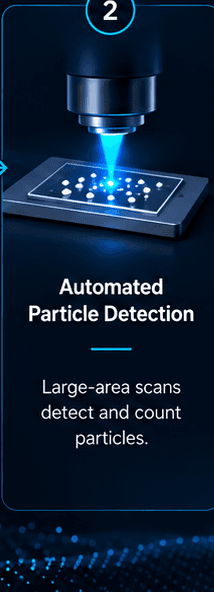
2. Automated Particle Detection
Detect and locate the optical particle population across the scanned area.

3. Multimodal Imaging & Calibrated Morphology
Link complementary image modes with calibrated particle length, width and morphology.

4. DeepMorph / Targeting Logic
Use image-trained selection to retain analytically relevant structures. DeepMorph enriches candidates before Raman chemical confirmation.

5. Automated Raman Acquisition
Acquire Raman spectra from the selected particle targets while retaining their image coordinates.

6. Chemical Identification & Reference Comparison
Compare measured Raman fingerprints with spectral libraries and application-specific reference materials.

7. Population Statistics & Reviewed Report
Connect Population, Targeted Selection, Raman Analysis and Confirmed Identity in a reviewed, traceable report.

Particle Counting
Quantify the detected optical population.

Size Distributions
Describe particle size across a defined analytical range.

2D Morphology
Measure calibrated length, width and shape.

Multimodal Imaging
Retain complementary image-derived context.

DeepMorph Targeting
Use image-trained selection to retain analytically relevant structures.

Raman Identification
Confirm chemical identity using measured Raman fingerprints.

Reference Comparison
Compare unknown particles with relevant reference fingerprints.
Discuss how the workflow could fit your particle-analysis question.
Discuss your analysis